

Wisconsin's Population Problem Is a Wound America Made. More Visas Won't Heal It.
A response to the place-based immigration proposal making the rounds in Midwest policy circles.

A recent Daily Mail article profiles Jonathan Burkham, an associate professor of human geography at the University of Wisconsin-Whitewater, who has written a book proposing a “place-based immigration policy” to arrest Wisconsin’s projected population decline of roughly 200,000 people by 2050. The proposal is not new. Versions of it have circulated in Midwest policy circles for years, drawing bipartisan support from mayors desperate for solutions.
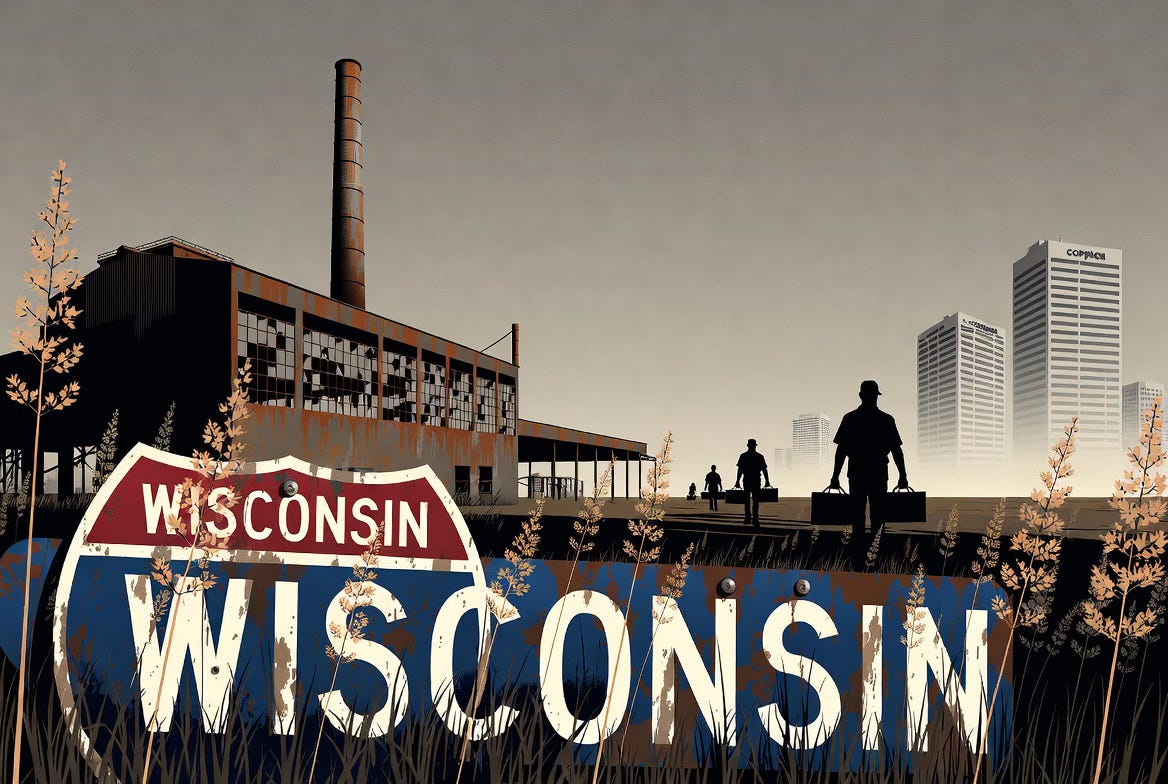
Wisconsin’s demographic picture is in line with the United States. Fertility rates sit at 1.6 children per woman against a current replacement level of 2.1, which is the same as the United States in 2020. No realistic immigration scenario can fully compensate for that. Meanwhile, the economic conditions that have made family formation increasingly unaffordable and unattractive for young Wisconsinites have not been addressed. As a result, the state has hemorrhaged roughly 10,000 net domestic Americans per year since 2010. Its labor force shrank by 50,000 to 60,000 workers in a single recent year due to Boomer retirements. It should be noted the Boomer generation was a byproduct of an all-encompassing World War and resulting unparalleled U.S. dominance, which is not replicable. Furthermore, Boomers were an exception because birthrates spiked after generations of decline from 7 children in 1835 to 2.1 children in 1935.
But Professor Burkham’s prescription, directing more immigration flows toward states like Wisconsin through a new visa architecture, treats a symptom while sidestepping the disease entirely. His proposal doesn’t seriously grapple with why Wisconsin has been losing its own people for decades, or with the uncomfortable reality that the guest worker programs already on the books have largely served corporate interests rather than the workers and communities they were sold as helping. Burkham himself does acknowledge the limits of a high-skill-only approach, telling the Daily Mail he worries about proposals that “prioritize high-skilled immigrants so much that I wonder who’s going to be doing the truck driving and other things like that.” Which is an uninformed statement to make to the millions of hardworking American truckers out there.
The Wound America Made in Wisconsin
Wisconsin’s demographic decline did not arrive from nowhere. It is, in substantial part, the downstream consequence of forty years of deindustrialization that hollowed out the economic foundation on which young Wisconsinites built households, formed families, and stayed.
In 1985, Wisconsin had somewhere between 630,000 and 660,000 manufacturing jobs, and manufacturing represented roughly 25 to 28 percent of total employment in the state. Today, after a 21.6 percent decline since 2000 alone, Wisconsin employs closer to 470,000 manufacturing workers. The losses were not evenly distributed across time. The decade from 2000 to 2010, when China entered the World Trade Organization and the Great Recession struck, was catastrophic, erasing the bulk of manufacturing employment that had survived the gradual erosion of the 1980s and 1990s.
These were not abstract economic statistics. They were the jobs that allowed an 18-year-old in Janesville or Kenosha or Oshkosh to walk off a high school graduation stage and into a wage sufficient to rent an apartment, form a household, and begin a life, without a college degree, without debt, and without waiting until their late twenties to achieve the economic stability that previous generations reached in their early twenties. The General Motors plant in Janesville, which closed in 2008, had employed workers who did exactly this for generations. When it closed, those workers and their children faced a choice between staying in a community with diminished economic prospects or leaving.
Many left. Wisconsin’s shift from a net in-migration state to a net out-migration state corresponds almost exactly with the acceleration of manufacturing job losses after 2000. The population decline Burkham seeks to solve with new visas is, at its root, a story about what happened when the middle-class economic pathway was systematically removed from a generation of Wisconsin workers through trade policy, corporate decision-making, guest workers, and automation.
This matters because it reframes the policy question entirely. Wisconsin does not have a population problem that immigration can fix. Wisconsin has an economic opportunity problem that drove its own people away, and that problem remains structurally unaddressed.
The Programs We Already Have — and Who They Actually Serve
Before designing new visa categories, it is worth examining in some detail how the existing high-skilled immigration programs, H-1B visas and the STEM Optional Practical Training program, actually function in practice. The gap between their stated purpose and their real-world operation is instructive.
The H-1B Program: Design vs. Reality
The H-1B visa was established by Congress in 1990 to allow U.S. employers to hire foreign workers in “specialty occupations” that Americans were working in. The annual statutory cap was set at 65,000, with 20,000 additional visas for workers holding advanced degrees from U.S. institutions.

What have been the results of the program? Consider the following pattern, documented by the Economic Policy Institute: the top 30 H-1B employers hired 34,000 new H-1B workers in 2022 while simultaneously laying off at least 85,000 workers in 2022 and the first quarter of 2023. Amazon, the single largest H-1B employer, hired 6,400 new H-1B workers in 2022 while laying off or planning to lay off 27,150 employees, more than twice the number of H-1B workers it had hired in the two preceding years combined. Meta, Google, Intel, Qualcomm…the pattern repeats across the technology sector with striking consistency.
A Bloomberg investigation revealed that from 2020 to 2023, the H-1B lottery itself was systematically gamed: staffing and outsourcing firms submitted multiple registrations for the same individuals through affiliated shell companies, dramatically increasing their selection odds. Nearly half of all H-1B visas during this period went to firms offering lower wages and less-skilled roles. The program was not selecting the best and brightest through a fair process and was instead being captured by the firms with the most sophisticated understanding of its regulatory loopholes.
Thirteen of the top 30 H-1B employers are IT outsourcing firms, companies whose entire business model involves placing foreign workers at American client sites, often replacing existing American employees in the process. A Cognizant class-action judgment in October 2024 found the company liable for intentionally discriminating against more than 2,000 non-Indian employees between 2013 and 2022, replacing them with lower-paid workers obtained through the H-1B program. What more needs to be said about the negative impacts of the H-1B visa program?
STEM OPT: The Program Congress Never Authorized
If H-1B represents a congressional program captured by corporate interests, STEM Optional Practical Training represents something more troubling: a program that was designed by corporate interests from its inception, created not by Congress but by executive-branch regulation at the explicit request of industry lobbyists, particularly Microsoft.
Here is what the program does in practice: F-1 student visa holders who complete STEM degrees at U.S. universities may work in the United States for up to three years (12 months of standard OPT plus a 24-month STEM extension) without being subject to the H-1B annual cap. There are no enforceable wage standards. Employers are not required to advertise positions to American workers before hiring OPT participants. And crucially, both the OPT worker and their employer are exempt from paying Social Security and Medicare payroll taxes, a 15 percent discount on total labor costs. It is not because the OPT worker is more productive or more skilled, but because a regulatory exemption makes them artificially cheaper. As a result, the program is an artificial government subsidy impacting entry-level American STEM positions.
According to the Institute for Progress, approximately 220,000 students participated in STEM OPT in 2022, yet the program was created without a single congressional vote. It was designed in 2007 by the Department of Homeland Security working in secret with industry lobbyists at Microsoft’s request, explicitly to circumvent the H-1B cap that Congress refused to expand. The program was challenged in court, vacated by a federal district court for procedural violations, and then reissued by the Obama administration in 2016 in its current expanded form.
The median annual wage in IT occupations rose just 3 percent between 2014 and 2019, while employment in those fields jumped 18.7 percent. In a genuine labor shortage, wages rise sharply. Instead, we have wage depression for American workers.
What This Means for Wisconsin Specifically
Burkham envisions immigrants filling the jobs Wisconsin employers can’t staff: healthcare workers, agricultural laborers, manufacturers, and yes, truck drivers. The Daily Mail piece lists these shortages as self-evident justification for his proposal. However, part of the reason these positions have gone understaffed is because the employment of guest workers has made them insufficiently attractive to the domestic workforce that already lives there.
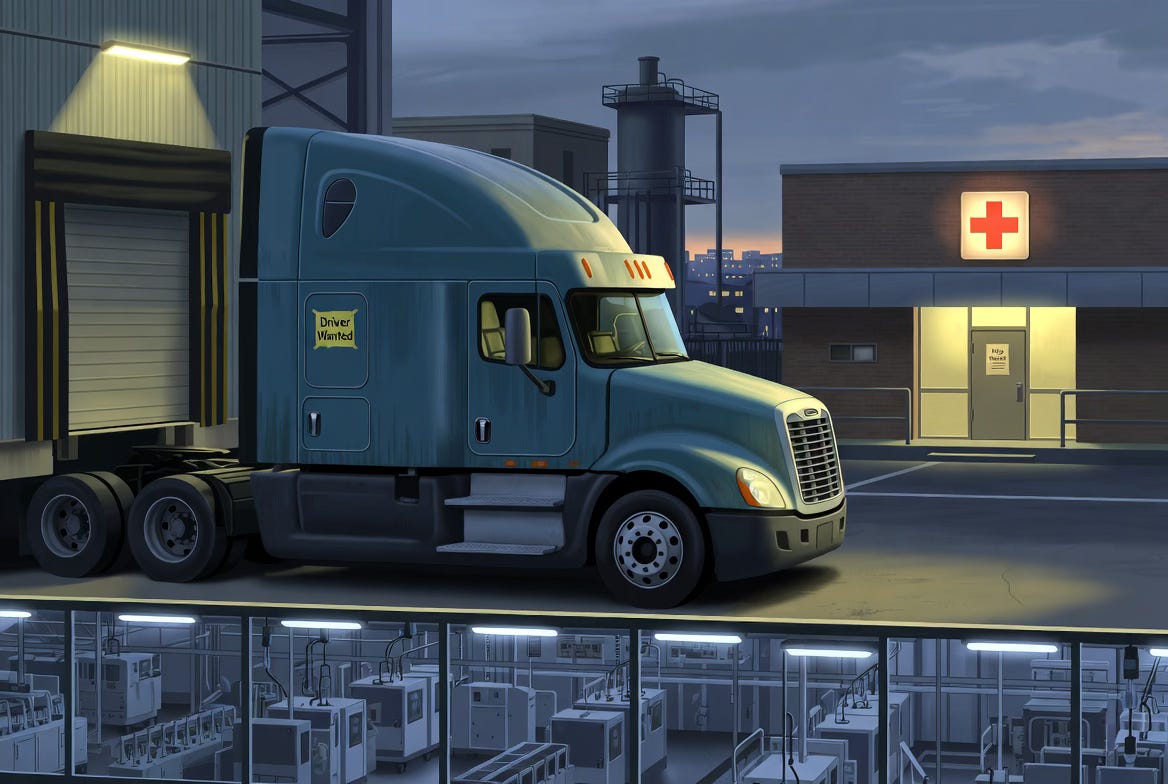
Wisconsin’s nursing homes and hospitals face staffing shortages not because there are no Americans willing to do the work, but because pay and working conditions in those sectors have not kept pace with what workers can earn elsewhere. Wisconsin’s farms have held agricultural wages down by using H-2A visas in agriculture. Adding a new place-based visa category would add to the undercutting of American labor.
The proposal also does not confront the structural problems with the existing programs it would presumably complement or expand. If the H-1B program can be used by Amazon to hire 6,400 workers while laying off 27,000 others, a place-based variant could be used by Wisconsin employers in precisely the same manner, filling positions with lower-cost foreign workers while American workers in those same communities are displaced or priced out.
The departure of Wisconsin’s own people is not a demographic problem that can be solved with imported labor. Examining how to bring Americans back to Wisconsin is the better solution.
What Should Actually Be on the Table
Why are we designing new immigration pathways while existing programs remain vehicles for wage suppression and worker displacement? What would it actually take to make Wisconsin hospitable to the people it has already lost? Advanced manufacturing, the skilled trades, and healthcare all represent genuine economic opportunities, but they require wages that make staying in Wisconsin competitive with leaving. Wisconsin’s technical colleges and apprenticeship programs are underutilized assets. The state’s relative housing affordability is a genuine advantage, but it matters only if there are jobs worth staying for.
And finally, whose interests does this immigration debate actually serve? The bipartisan support Burkham cites, from mayors, from business associations, and from the 2025 Conference of Mayors, reflects, in the main, the interests of employers seeking labor cost relief. Their interests are not the same interests as the Wisconsin workers who left Janesville when GM closed in 2008, or the young Wisconsinites who can’t afford to form households on what the state’s labor market currently offers them.
A state that could in the past support working adults and families was ravaged by deindustrialization from policies set in Washington, DC. Immigration policy cannot repair the damage done from industrial policy failure, and only by investing in Wisconsinites can the state improve itself.
PS: If you haven't already, consider subscribing — and if you're able, a paid subscription directly funds our ability to expand our work.