

The Builder and the Extractors
What two property management software companies tell us about American capitalism, American workers, and where we are headed

There is a tale of two software companies that tells you nearly everything you need to know about the American economy in 2026: a company that builds, a company that extracts, and the people who pay the price when the extractors are done.
Both companies sell property management software. They compete in the same market, serve many of the same customers, and offer products that on the surface look remarkably similar. But they represent entirely different philosophies of what a company is for, who it serves, and what obligations it carries to the people who built it. One of them is a case study in what American capitalism can produce at its best. The other is a cautionary tale about what it has become.
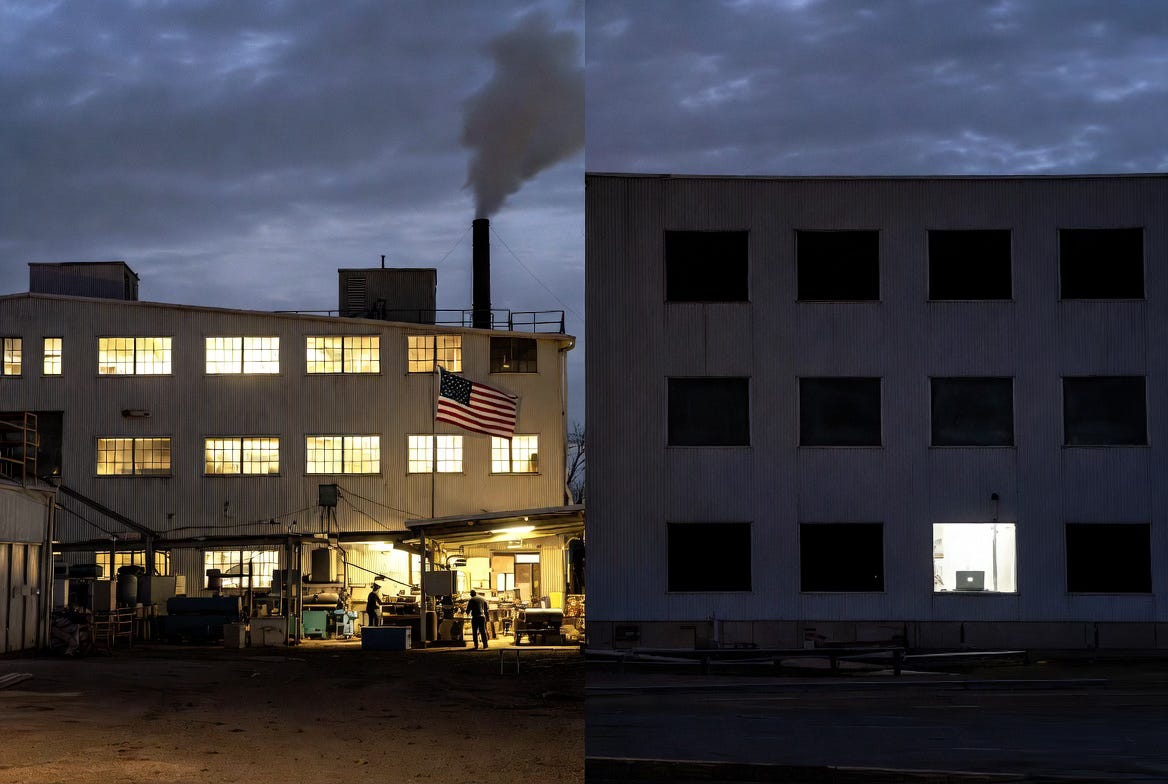
The first company is Yardi Systems. The second is MRI Software. And the distance between them is the distance between a country that builds things and a country that financializes them.
The Builder
Anant Yardi founded Yardi Systems in 1984 in Santa Barbara, California. He has run it ever since. He has never taken outside investment. He has never sold to a private equity (PE) firm. He has never taken the company public. For more than four decades, he has simply built, year after year, product after product, customer after customer, a property management software platform so deeply embedded in its clients’ operations that switching costs are nearly prohibitive.
The results are extraordinary by any measure. By 2024, Yardi had grown to approximately $1.6 billion in annual revenue with more than 20,000 customers worldwide. Every dollar of that revenue was earned organically. There is no leveraged buyout debt on the balance sheet. There are no PE partners marking the company to market every quarter. There is no Goldman Sachs mandate to prepare for a dual-track sale process. There is a founder who built something, kept building it, and trusted his American workforce to grow it with him.
That workforce matters. Yardi’s competitive advantage is not, at its core, a codebase. Codebases can be copied, reverse-engineered, and eventually commoditized. Yardi’s advantage is the institutional knowledge, customer relationships, and organizational continuity that its employees have accumulated over decades of working inside one of the most complex and relationship-dependent industries in the American economy—real estate. You do not build that in Hyderabad. You do not acquire it through a roll-up. You cultivate it over years, and you keep it by treating the people who carry it as assets rather than line items.
This is what patient capital looks like. This is what a founder-led, long-horizon business produces when it is allowed to operate outside the quarterly earnings cycle and the PE return model. It is not glamorous. It does not generate carried interest. It will never be the subject of a breathless TechCrunch piece about a unicorn exit. It is simply excellent, and it endures.
Yardi is, in the truest sense, an aspirational American success story. A founder with a vision, a workforce that believed in it, four decades of compounding, and a company that today serves millions of people who live and work in properties managed on its platform. This is the kind of business that used to be the norm. It is increasingly the exception.
The Extractors
MRI Software has a different story. Founded in 1971, it was for decades a solid if unremarkable competitor in the same property tech space. It was a company with good products, loyal customers, and a reputation built on decades of reliable service. Then came the private equity era.
Today MRI is owned by a consortium—TA Associates, Harvest Partners, and GI Partners—who have grown it primarily through acquisition, layering product upon product in the classic roll-up model. The platform is wide. The integration is, by many accounts, something less than seamless. And the ownership group, having engaged Goldman Sachs to advise on strategic options, is now targeting an exit that could value the company at up to $10 billion.
That is the context for what was announced this week: MRI is laying off between 350 and 400 American workers — roughly one third of its domestic workforce — while simultaneously accelerating its offshoring operations to India. There will be no press conference. There will be no congressional hearing. There will be, in all likelihood, a tastefully worded press release about “operational optimization” and “global resource alignment.”
The stirrings of the current business model were first noticed by employees when MRI’s CEO Pat Ghilani posited something so banal it deserves to be framed: “Other companies are doing this.”
He is not wrong. They are. And that is precisely the problem.
The Mechanism Nobody Names
Before we go further, it is worth pausing on something, because MRI’s story contains a detail that is more important than the headline number of layoffs.
This is not the Disney scandal of 2015, where American IT workers were marched into rooms and required to train their H-1B visa replacements with the humiliation so visible, so documented, and so appalling that it generated genuine congressional outrage and front-page coverage in the New York Times. This is not the Vanguard or CSX model, where American workers were formally “rebadged” to Indian IT consulting firms in a transaction legible enough to litigate. Those cases had a smoking gun. A named consulting firm. A paper trail. A moment of identifiable wrongdoing.
What MRI has done—what many American technology companies are now doing—is something more patient. More methodical. More deniable.
An MRI employee described to me how the process unfolds in practice. It begins gently. American workers are asked to collaborate with a new team of developers in India. The framing is collegial: can you help these guys get up to speed? Over the following months, the offshore team begins sitting in on meetings. Then leading sections of meetings. Then owning sections of the codebase. Then owning entire products. The timeline varies with the complexity of the software involved. In most cases, the American worker is fully replaceable within one to two years. In one case this employee described to me, the software was so architecturally complex that it took three full years before management felt confident enough to act.
For those three years, the American worker showed up every day, performed their job with professional diligence, helped their overseas colleagues learn it, and waited.
“For a long time,” this employee told me, “it felt like we were just sitting in prison, waiting to be called before the firing squad.”

This is the mechanism that has no name in our political vocabulary. It is not outsourcing in the traditional sense. It is not a plant closure you can photograph. It is not a rebadging. You can’t make a Freedom of Information Act (FOIA) request about it. It is a managed, multi-year knowledge transfer, disguised as collaboration and executed as displacement, that ends with an American worker handing over the keys to their own livelihood and being thanked for their service on the way out.
It is the most insidious form of American worker displacement because it recruits the worker as an instrument of their own replacement and then fires them for having done the job too well.
Other Companies Are Doing This
Pat Ghilani’s justification, that other companies are doing this, deserves a fuller examination than he perhaps intended because he is describing not a defense but an epidemic.
Marc Benioff, CEO of Salesforce and one of the most celebrated technology executives in America, announced last year that his company would not hire a single new engineer in 2025. His support workforce had already been cut nearly in half, from 9,000 to approximately 5,000 employees. Meanwhile, Salesforce has been expanding its innovation centers in Hyderabad and Bangalore, aggressively increasing engineering, sales, and consulting hiring across India. On an earnings call, Benioff declared: “My message to CEOs right now is that we are the last generation to manage only humans.”
The last generation to manage only humans. There is a vision of the American workforce embedded in that sentence that should alarm every salaried professional in this country, regardless of industry. Benioff is not an outlier; he is simply the most candid.
The pattern repeats across enterprise software, financial services, healthcare administration, and insurance. American companies that once competed on the quality of their domestic workforce now compete on how efficiently they can transfer that workforce’s knowledge offshore and then eliminate it. The workers who built the products, cultivated the customer relationships, and generated the institutional knowledge that made these companies valuable are being systematically converted from assets into liabilities, and replaced by cheaper labor abroad before anyone notices.
The Schumpeterian Irony
Here is what makes the MRI story particularly instructive and particularly bitter.
Yardi’s success, $1.6 billion in organic revenue, forty-plus years of compounding growth, and a customer base so loyal it constitutes a genuine competitive advantage, is precisely what MRI’s private equity partners aspire to replicate. They want the valuation that comes with that kind of entrenched market position. They want the recurring revenue, the switching costs, and the enterprise relationships that justify a $10 billion price tag.
But they are pursuing it by systematically destroying the very things that produced it.
Yardi’s advantage did not come from its codebase. It came from the people who built it, maintained it, and sat across the table from property managers in Cincinnati and commercial landlords in Dallas and affordable housing operators in Phoenix and learned, over years, exactly what those customers needed. That knowledge lives in people. It is not transferable to a spreadsheet. It does not survive a layoff notice.
When you cut a third of your domestic workforce and offshore the institutional knowledge that justified your valuation, you are not optimizing an asset. What your actually doing is liquidating it: just slowly enough that the buyer may not discover the damage until after the deal closes. The PE partners will be long gone with their carried interest by the time the customer attrition begins showing up in the renewal numbers. The incentive horizon is catastrophically misaligned with the long-term health of the business. And the people who built that business will be the ones who absorb the consequences.

There is a word for this in economic theory. Joseph Schumpeter called it “creative destruction“—the process by which capitalism tears down the old to build the new. But what is happening at MRI, and at Salesforce, and across the American technology sector is not creative destruction. There is nothing being created. There is only extraction: of margin, of institutional knowledge, and of human capital accumulated over careers, in service of a transaction that enriches a small number of partners and leaves the enterprise weaker than they found it.
The Political Failure
Now consider the political moment in which all of this is occurring.
Donald Trump won the presidency in significant part on the promise that the economic displacement of the American worker — the dislocation that politicians of both parties had acknowledged and ignored for thirty years — would finally be addressed. On manufacturing, on tariffs, on trade policy, there is at least a coherent argument being made and a set of policies being attempted, however imperfectly and however disruptively.
But on this, on the slow, deniable, spreadsheet-mediated offshoring of the white-collar professional and salaried class, the Trump administration has no leverage, no policy mechanism, and no answer so far.
The H-1B visa program that provides the legal infrastructure for much of this offshore pipeline has some powerful champions both inside and outside the administration. The fiduciary and legal structures that compel PE-owned companies to optimize margins ahead of an exit are entirely untouched by any policy being contemplated in Washington. The regulatory framework that might give the government standing to identify, document, and intervene in a managed knowledge transfer disguised as professional collaboration simply does not exist. And the political constituency most affected, the white-collar professional class, the people whose displacement arrives as a calendar invite from HR rather than a plant closure announcement, does not yet fully understand what is being done to it or how to demand accountability for it.
This is a story of a thirty-year failure of both parties to reckon with the financialization of American business and its consequences for American workers at every level of the income distribution. The factory workers who lost their jobs to offshoring in the 1990s and 2000s were told they needed to get more education and move into the knowledge economy. The knowledge economy workers who are losing their jobs to offshoring now are being told what, exactly? To learn to code? The coders are going too.
What It Means
Anant Yardi built a $1.6 billion company by doing something unfashionable: he treated his American workforce as the source of his competitive advantage rather than the primary target for cost reduction. He was right, and his company’s four decades of organic growth prove it.
The private equity owners of MRI Software looked at a company with a genuine market position, real customer loyalty, and a talented American workforce and saw something different: a margin improvement opportunity and an exit multiple. They may get their $10 billion. But they will leave behind a company with a hollowed-out workforce, degraded institutional knowledge, and customers who are quietly beginning to wonder whether Yardi might be worth the switching cost after all.
Pat Ghilani told his workers, not long ago, that they were the people who made MRI’s success happen. That it was all because of them. He meant it, I believe. And now he is letting private equity fire them, one managed knowledge transfer at a time, while the workers who remain sit at their desks feeling, in the words of one of their colleagues, like prisoners waiting to be called before the firing squad.
This is what American capitalism looks like in 2026 for the white-collar professional class. Not a dramatic collapse. Not a visible injustice that photographs well and moves senators. Just a quiet, methodical, deniable process of extraction, disguised as collaboration, executed as displacement, that will not appear in any political speech and will not be addressed by any policy currently under consideration in Washington.
Winter is coming for the salaried class. The question is when will they begin to fight back?