

No Red Carpet for Modi

Prior to Indian Prime Minister Narendra Modi's arrival at the White House on Thursday, February 13th, both Indian press and several U.S.-based outlets were speculating that H-1B visas and the Indian diaspora would take center stage. They didn't.
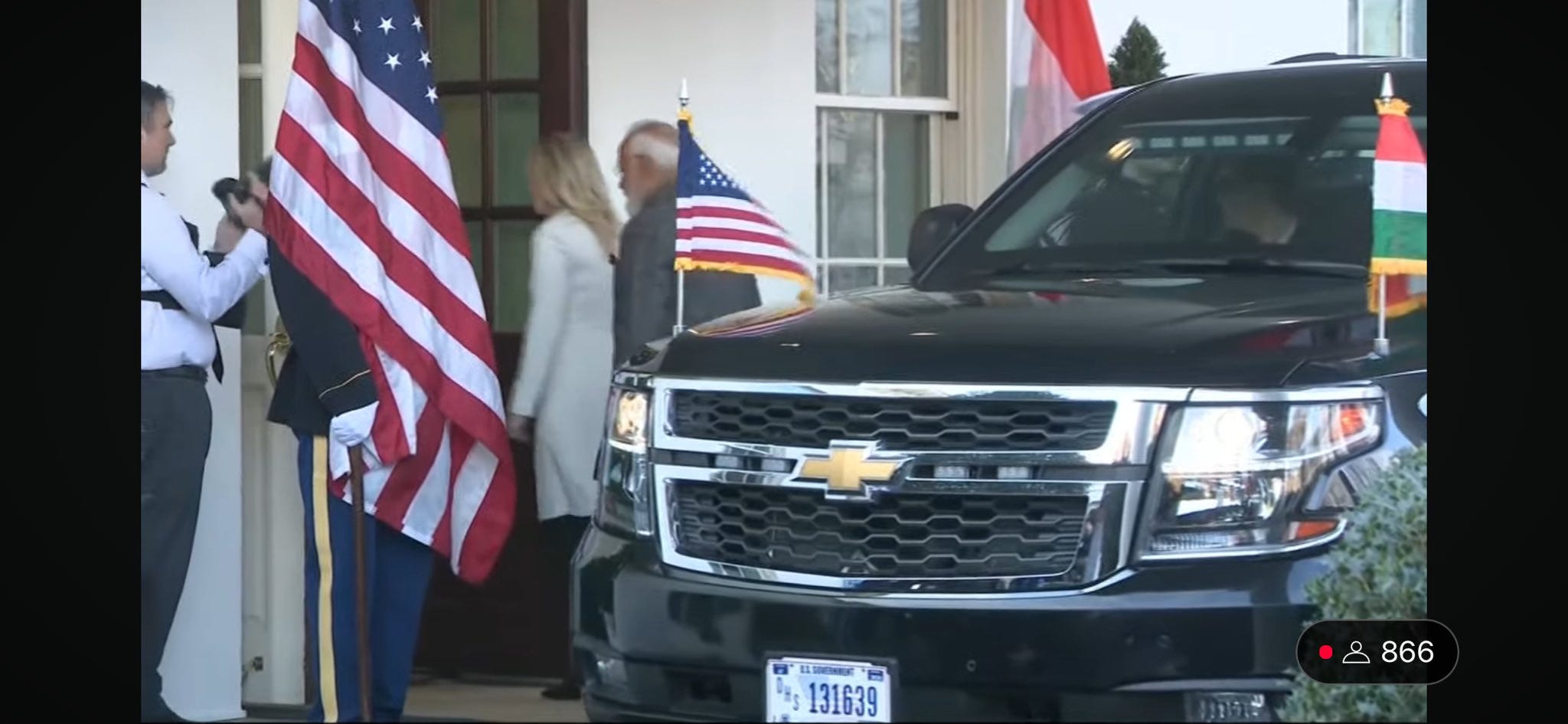
The H-1B visa topic not only failed to figure prominently in discussions between Modi and President Trump—it wasn't discussed at all. Even in Modi's meeting with Elon Musk, the subject never arose. Adding to this apparent slight and in contrast his 2019 "Howdy Modi" event in Houston where Trump appeared alongside him, Modi didn't receive the traditional red carpet treatment.
During my time as a counterintelligence officer in the 1980s, a mentor often emphasized the importance of noting not just what people say, but what they don't say. I believe what remained unsaid in these meetings could fill volumes, for two key reasons:
First, although Modi has been firm in his public statements opposing de-dollarization, it's widely understood that most, if not all, BRICS nations (including India) would prefer to end dollar hegemony and its position as the world's reserve currency. Notably, on the same day as the Modi meeting, Trump declared that targeted tariffs and incentive structures would be used to discourage countries from pursuing de-dollarization policies.
Second, multiple sources indicate that H-1B visas and related issues, such as ending country cap quotas, have become "radioactive" on Capitol Hill. No politician appears willing to weather the backlash that would come from proposing legislation like the Eagle Act in the 119th Congress. Furthermore, illegal immigration and mass deportation issues are currently dominating the political discourse, leaving little room for reform of programs like H-1B and Optional Practical Training.
Let there be no misunderstanding: the work of our activists, sister organizations, social media influencers, and the small group of journalists who share our worldview has brought us to this point. We are shaping policy, albeit defensively, and we can take pride in this achievement.
However, much work remains. We need to quadruple the number of tech workers reaching out to Congress and supporting our programs and initiatives to fight against displacement by employment-based visa programs and offshoring. Onward!
I'm glad to get this report regarding Modi's visit. You are correct to observe what is not being said. I feel like all of the work I and other Americans have been doing during the past 30+ years to oppose the hollowing out of America via the controversial H-1B Visa program is beginning to bear fruit. To learn more, there is a sampling of my articles via the Google search of both phrases, "Gene Nelson" and "H-1b" - there were a meager 67 articles. My August 5, 1999 U.S. House of Representatives testimony opposing the H-1b Visa is no longer the first search result. Somehow the URL for this House hearing has been obscured. https://commdocs.house.gov/committees/judiciary/hju63314.000/hju63314_0f.htm
My likely explanation is "Follow the Money." Employer penury is the underlying cause.
The end of dollar hegemony would be painful but it would force the US to produce and export to pay for imports and possibly lower the cost of American imports abroad through dollar devaluation, while shrinking the U.S. finance industry.
And this would be bad because….?