

Beyond Border Security: Why "Net Zero" Immigration Requires Legal Immigration Limits

Recent headlines suggesting the United States is approaching "net zero migration" ignore a key source of permanent migration: temporary legal work permit programs. While the Trump administration's focus on border security and illegal immigration enforcement is important and has been successful, the next challenge lies in confronting the uncomfortable truth about legal immigration's impact on American workers.
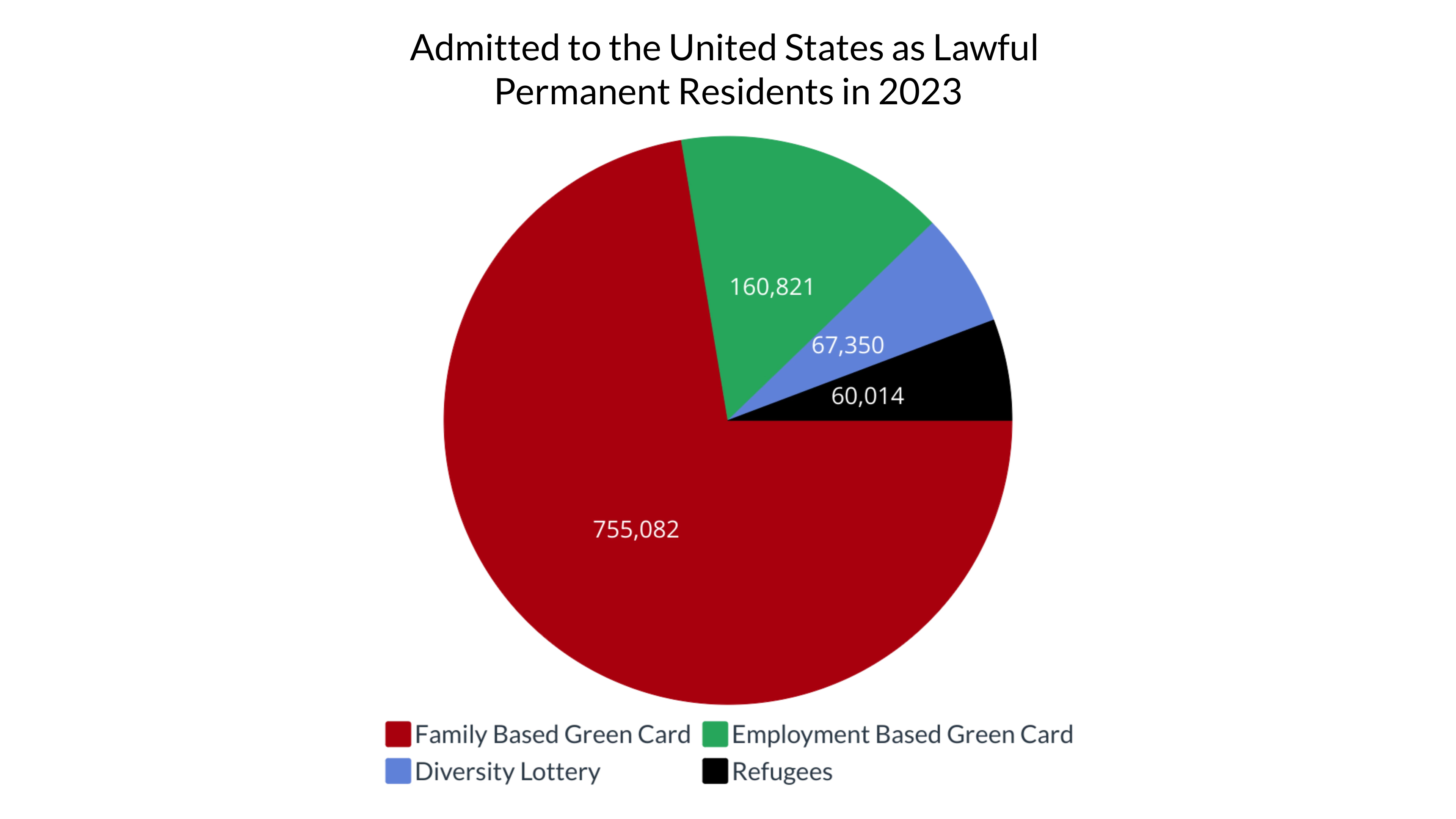
The numbers tell a story that contradicts the net-zero narrative. With over 2.1 million foreign workers currently in the United States on various employment visas alone, plus family-based and employment-based immigration (1.2 million new green cards granted in 2023), refugee admissions, and the diversity lottery, legal immigration now dwarfs illegal border crossings. Any serious discussion of immigration reform cannot ignore this reality.
Legal Workers in the STEM Sector
For decades, American policymakers have accepted at face value industry claims about critical labor shortages justifying expanded immigration programs, especially in STEM. This narrative deserves rigorous scrutiny, particularly considering the mounting evidence that challenges its basic premises.
Consider the STEM workforce, often cited as the poster child for immigration necessity. Industry advocates routinely warn of dire shortages requiring H-1B visas, STEM OPT programs, and other employment-based immigration to fill critical gaps. Yet the data reveals a starkly different picture. The Institute for Sound Public Policy revealed the bleak situation that faced American computer science graduates, with stagnant salaries and high unemployment, which is a clear indication that the domestic supply of qualified workers exceeds demand. If genuine shortages existed, we would expect to see rapidly rising wages and fierce competition for American STEM graduates. Instead, many find themselves working outside their fields of study while companies import foreign workers on visas.
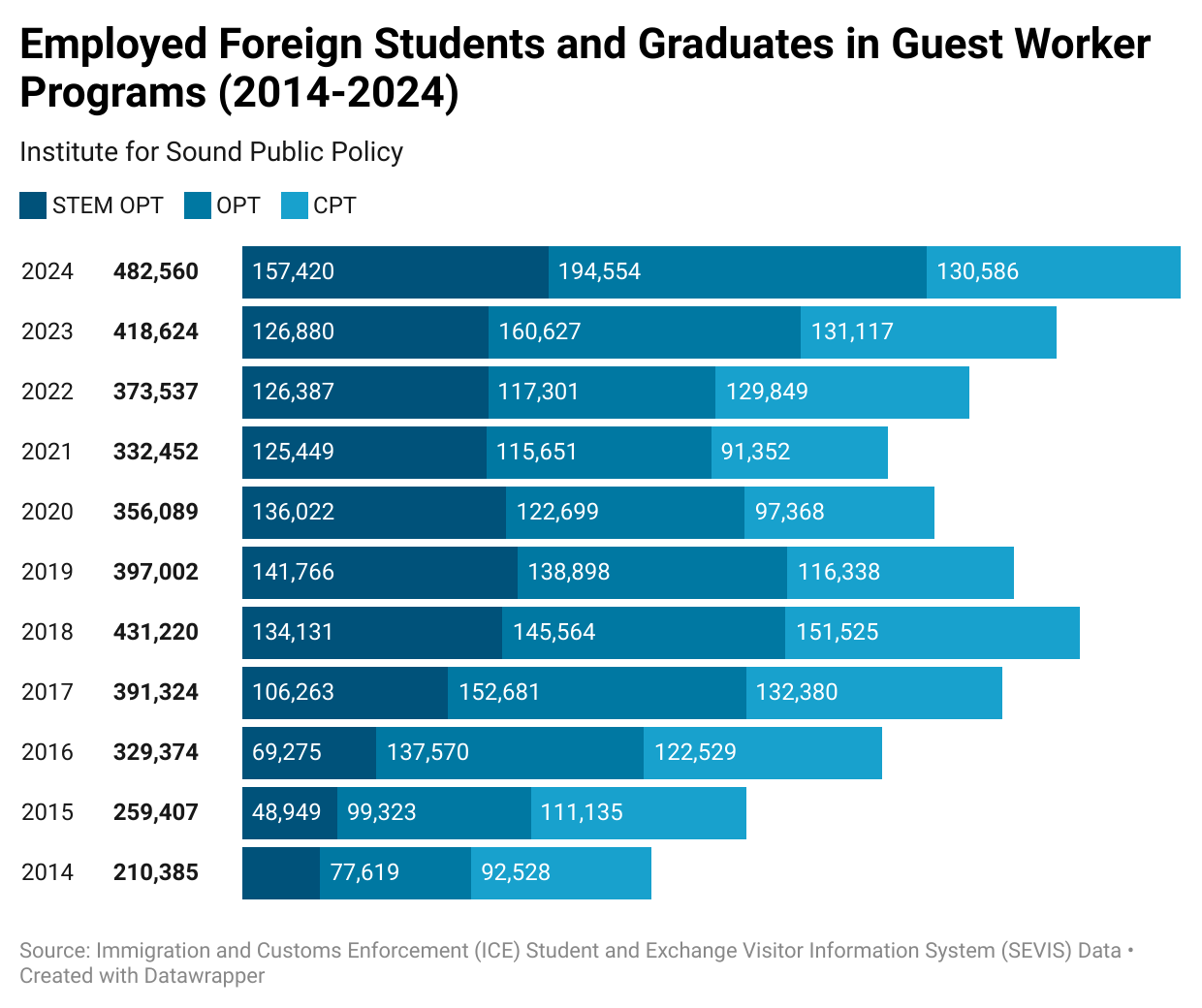
The H-1B program exemplifies this dynamic, with 659,305 foreign workers currently in the country on those visas. Additionally, there are 482,560 foreigners on various student work programs (OPT, STEM OPT, and CPT), which has grown 129% in the past decade. In total, we're looking at over 1.1 million foreign workers concentrated in supposedly STEM "shortage" occupations. Yet wage data shows no evidence of the dramatic salary increases that genuine scarcity would produce. The uncomfortable reality is that these programs often function less as shortage-fillers and more as wage-suppression mechanisms.
Legal Workers in the Agriculture and Seasonal Sectors
Agricultural and seasonal labor present similar contradictions. The H-2A (for agricultural work) and H-2B programs (for non-agricultural, temporary, seasonal work), covering 442,341 workers, are justified by claims that Americans won't perform farm or seasonal work. Yet this assertion ignores basic economic principles. Americans have historically performed seasonal labor when wages and working conditions made it economically attractive. The current situation reflects not American unwillingness to work, but employer unwillingness to pay competitive wages and provide decent working conditions when cheaper foreign alternatives exist.
The labor shortage narrative also ignores technological alternatives that could reduce immigration dependence in agriculture. As IfSPP analyst Joe Guzzardi pointed out in his article titled, Once Thought Impossible, Robots Can Harvest Ripe Strawberries, agricultural robotics, while still developing, show promise for offsetting farm labor needs. Robotic systems excel at harvesting uniform crops like grains and are increasingly viable for fruits grown in structured environments. While delicate crops like strawberries and asparagus remain challenging for automation, continued labor shortages would accelerate innovation in these areas. Restricting these programs would force necessary adjustments that could ultimately strengthen American competitiveness.
Real Reform Requires Legal Work Program Limits
Meaningful immigration reform must go beyond border security and deportations to address legal immigration's scale and structure. The current system admits over one million legal permanent residents annually, plus we admit at least 1.1 million temporary visa workers per year. This volume overwhelms labor markets in specific sectors and suppresses wages across skill levels.
Consider the total number of foreigners in the country on employment visas alone in 2024:
659,305 H-1B workers in specialized occupations in 2024 (Source: Institute for Sound Public Policy)
482,560 foreign students and graduates on work authorization programs in 2024 (Source: Institute for Sound Public Policy)
387,397 L-1 intracompany transferees in 2019 (Source: Cato Institute)
470,000 seasonal agricultural and non-agricultural workers (Source: Economic Policy Institute)
150,000 H-4 visa dependent spouses with work authorization in 2024 (Source: Institute for Sound Public Policy)
Achieving genuine net zero migration would require dramatic reductions across these categories—reductions that would immediately benefit American workers through reduced labor competition and upward wage pressure.
The Benefits for American Workers
Restricting legal immigration would produce several immediate benefits for American workers:
Wage Growth: Reduced labor supply would force employers to compete for workers through higher wages, particularly benefiting entry-level and mid-skilled positions that face direct immigrant competition.
Investment in Training: Labor shortages would incentivize employers to invest in training American workers rather than importing foreign alternatives. This would particularly benefit younger Americans and those seeking career changes.
Automation and Productivity: Genuine labor scarcity would accelerate business investment in productivity-enhancing technology, ultimately strengthening American competitiveness.
Reduced Credential Inflation: With fewer foreign workers holding advanced degrees, employers might focus more on skills and experience rather than educational credentials, opening opportunities for Americans without college degrees.
Solutions
The Trump administration has an opportunity to address legal immigration's economic impact. This requires:
H-1B Changes: Focus solely on truly exceptional cases rather than routine IT and healthcare staffing. Additionally, increasing scrutiny, adding procedural hurdles, and raising denial rates will reduce approvals and deter employers from exploiting the current system, like they currently do. Any bigger changes require Congress.
STEM Program Elimination: End OPT and STEM OPT programs that allow foreign students to remain and work, forcing American employers to recruit domestically.
Agricultural and Seasonal Workforce Visa Reform: Phase down H-2A and H-2B programs while providing adjustment periods for automation investment.
Such reforms would undoubtedly face fierce opposition from business interests that benefit from cheap labor and immigration advocates who conflate any restrictions with xenophobia. But the evidence suggests that current immigration levels serve corporate interests more than worker interests or long-term American prosperity.
Conclusion
The recent narrative about approaching net zero migration obscures the real policy choices America faces. Border security and deportation programs, while necessary, address only a fraction of total immigration flows. Real reform requires confronting legal immigration's scale and impact on American workers across skill levels.
The global demographic trends, labor market evidence, and fiscal realities all point toward the same conclusion: America can and should dramatically reduce immigration levels to benefit existing citizens. The technology exists to offset much agricultural labor, domestic STEM graduates are underutilized, and wage suppression across specific industries reflects legal immigration-driven labor oversupply rather than genuine market dynamics. President Trump's administration has the opportunity to challenge powerful business interests and implement the legal immigration restrictions that benefit American workers: higher wages, better working conditions, and expanded opportunities.
And what about regular LEGAL immigration? It, the last I heard, is still about 5 times higher than the low limits that the American people demanded and put into law in about 1924, or 200,000 a year. We are not a nation that in any way "needs" a million new citizens a year when we can't provide medicine, education or infrastructure at high levels for those of us already here.
I agree with this article, but I see no mention on how these work permit programs as well as legal immigration have destroyed all Black Americans communities! Especially in Los Angeles, California, all Black American communities have been wiped out. Most of the people working in the public and private sector are foreigners. Mostly Mexicans and other Hispanics. The mainstream corporate media have been silent on this issue.